COMMENTARY:
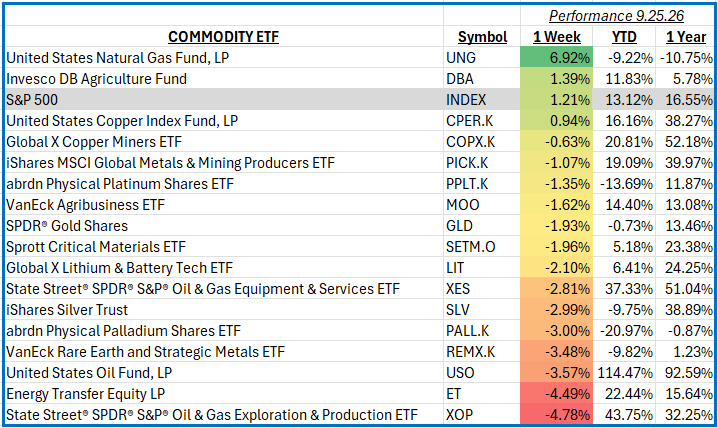
The S&P 500 gained 1.21% for the week ended September 25, while global commodity markets were shaped by three major forces: shifting Middle East supply risks, changing expectations for interest rates, and continued demand for metals and energy tied to electrification and infrastructure. Oil prices fell sharply early in the week as Saudi production flows improved and hopes emerged for a potential reopening of the Strait of Hormuz, while copper remained supported by expectations for Chinese demand and constrained supply.
Natural Gas & Energy: Natural gas was the strongest commodity theme, rising 6.92%, or 5.71 percentage points above the S&P 500. The move reflected continued attention to power demand from data centers and AI infrastructure, as well as the broader sensitivity of natural gas markets to global LNG supply. Cheniere Energy and EQT were among the companies providing important exposure to the natural-gas value chain. However, the week ended with natural gas prices pulling back as near-term supply and weather expectations moderated.
Agriculture: Agricultural commodities gained 1.39%, modestly exceeding the S&P 500’s 1.21% advance. Companies including Archer-Daniels-Midland, Bunge and Corteva provided exposure across crop processing, agricultural inputs and food production. Grain markets remained sensitive to harvest expectations and global supply conditions, while fertilizer availability continued to attract attention because disruptions to Middle Eastern energy markets can affect fertilizer production and transportation costs.
Copper & Industrial Metals: Copper gained 0.94%, supported by expectations for Chinese demand and ongoing concerns about constrained mine supply. Freeport-McMoRan and Southern Copper were among the important contributors to the copper and broader mining value chain. Copper also continued to benefit from longer-term demand associated with electrification, grid investment, data centers and infrastructure. Market commentary indicated that copper was heading toward a second consecutive weekly gain as investors focused on Chinese demand and tight supply conditions.
Precious Metals: Precious metals faced a more challenging environment as higher Treasury yields and a stronger dollar reduced the appeal of non-income-producing assets. Gold initially declined as expectations for additional Federal Reserve tightening increased, while silver showed greater resilience because of its industrial applications. Newmont, Barrick Mining and Agnico Eagle Mines remained important companies within the precious-metals value chain. Gold’s weakness illustrated the competing effects of geopolitical uncertainty and higher interest rates: geopolitical risk can support safe-haven demand, while higher yields can work in the opposite direction.
Oil, Energy Infrastructure & Commodities: Energy-related exposures were the weakest portion of the commodity complex. Energy infrastructure declined 4.49%, while oil exploration and production fell 4.78%. Exxon Mobil, Chevron, ConocoPhillips and EOG Resources were among the major companies influencing the group. Crude prices fell as Saudi pipeline operations improved and reports suggested Iran could reopen the Strait of Hormuz as part of a potential diplomatic arrangement. Those developments reduced some of the geopolitical risk premium embedded in oil prices, although the situation remained fluid.
Commodity markets reflected a tug-of-war between geopolitical supply risks, interest rates and longer-term structural demand. Natural gas and agriculture advanced, copper remained firm, while oil-related investments weakened as the market priced in the possibility of improving Middle East supply conditions. Overall, the week highlighted the continued importance of geopolitical developments in determining commodity-market direction.