COMMENTARY:
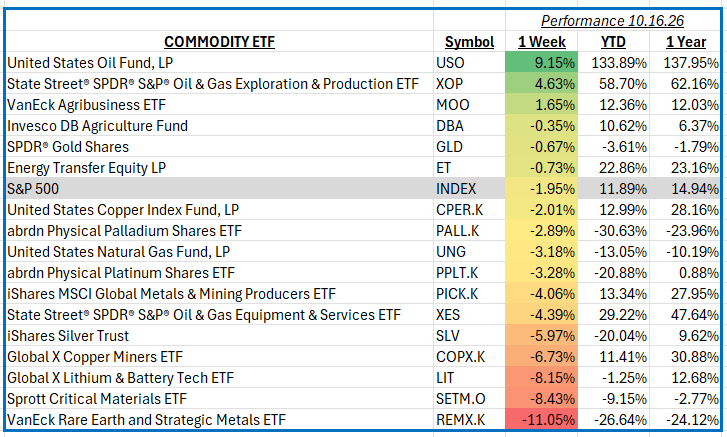
The S&P 500 declined 1.95% for the week ending October 16, as geopolitical tensions, inflation concerns, and technology-sector weakness influenced investor sentiment. Global commodity markets were dominated by three developments: escalating Middle East tensions pushed crude oil prices above $100 per barrel; stronger-than-expected U.S. inflation data complicated the outlook for Federal Reserve policy; and uncertainty surrounding China’s critical-mineral export restrictions weighed on strategic metals. These developments reinforced commodities’ importance as potential inflation hedges while highlighting significant differences across individual markets.
Energy and Oil Production: Energy was the strongest commodity-related investment theme. Crude oil exposure gained 9.15%, outperforming the S&P 500 by 11.10 percentage points and leading the three highlighted commodity categories. Brent crude approached $110 per barrel as attacks on energy infrastructure, disruptions around the Strait of Hormuz, and concerns about Russian petroleum supplies heightened fears of tighter global availability. Exploration and production companies, including Exxon Mobil, Chevron, and ConocoPhillips, benefited from stronger oil-price expectations. Oilfield services and pipeline infrastructure also attracted attention as investors assessed the implications of sustained energy-price increases.
Agriculture and Food Production: Agribusiness advanced 1.65%, supported by selective demand for agricultural inputs, equipment, and food-production businesses. Companies such as Deere, Corteva, Nutrien, and Archer-Daniels-Midland provide exposure to farm machinery, crop protection, fertilizers, and agricultural processing. However, higher energy prices present a mixed outlook: they can increase production costs for farmers while supporting demand for certain agricultural commodities and biofuel feedstocks. Investors continued evaluating the balance between input costs, crop demand, and global food supply.
Critical Minerals and Strategic Metals: Critical-materials investments declined 8.43%, while rare-earth and strategic-metals exposure fell 11.05%, making it the weakest highlighted category. The latter underperformed the S&P 500 by 9.10 percentage points. China’s export-control policies remained a significant concern, particularly for rare-earth elements and permanent magnets essential to electric vehicles, renewable energy, and advanced manufacturing. Companies including MP Materials, Lynas Rare Earths, and Albemarle faced investor scrutiny over supply-chain concentration, processing capacity, and demand expectations.
Precious Metals, Industrial Metals, and Natural Gas: Gold and silver experienced volatility as inflation concerns competed with safe-haven demand and movements in the U.S. dollar. Copper, lithium, platinum, and palladium remained sensitive to industrial demand and manufacturing expectations. Natural gas prices and related infrastructure investments reflected changing weather expectations, storage conditions, and energy-market dynamics. Mining companies such as Freeport-McMoRan and Southern Copper remained important indicators of industrial-metal sentiment.
Overall, energy led commodity performance, agriculture delivered modest gains, and strategic metals weakened sharply. Geopolitical developments, inflation, and supply-chain uncertainty will remain key drivers of commodity markets in the weeks ahead.