

COMMENTARY:
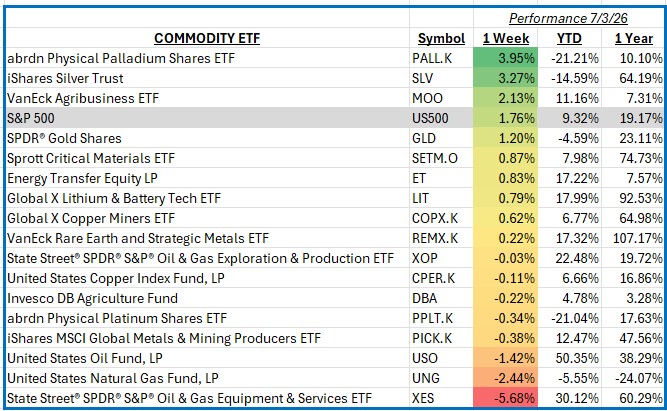
The S&P 500 advanced 1.76% during the week ending July 3 as investors headed into the Fourth of July holiday with growing confidence in the U.S. economy. A stronger-than-expected employment report, moderating inflation, and continued expectations for potential Federal Reserve interest rate cuts later this year helped support risk assets. Across global commodity markets, trading was mixed as investors balanced encouraging economic data against evolving supply and demand fundamentals. Much like the Independence Day holiday marks resilience and optimism, commodity markets reflected both confidence in long-term global growth and caution surrounding near-term geopolitical and macroeconomic developments.
Physical Palladium was the strongest-performing commodity exposure of the week, rising 3.9% as investors responded to improving expectations for industrial demand and tighter global supply conditions. Palladium remains a critical component in automotive catalytic converters, and renewed optimism surrounding global vehicle production supported prices. The advance also reflected ongoing concerns about supply disruptions from major producing regions, particularly Russia and South Africa. Precious metals producers with meaningful palladium exposure, including Sibanye-Stillwater, Impala Platinum Holdings, and Anglo American Platinum, were among the primary contributors to the week’s gains.
Silver also posted a strong week, advancing 3.3% as declining real interest rates and a weaker U.S. dollar increased demand for precious metals. Beyond its role as a defensive asset, silver continued to benefit from its growing importance in solar energy, electronics, and other industrial applications. Mining companies including Pan American Silver, Fresnillo, Wheaton Precious Metals, and First Majestic Silver contributed positively as investors favored companies with strong production growth and improving cash flow outlooks.
Agribusiness gained 2.1% as improving crop fundamentals, resilient global food demand, and expectations for continued infrastructure investment in agricultural productivity supported the sector. Investors favored companies supplying farm equipment, fertilizers, seeds, and agricultural chemicals as long-term demand for food production remained intact. Leading contributors included Deere & Company, Corteva, CF Industries, Archer Daniels Midland, and Bunge Global, all of which benefited from optimism surrounding agricultural spending and improving farm economics.
Energy-related commodities lagged during the week. Natural gas declined 2.4% as ample domestic inventories, mild weather forecasts, and steady production weighed on prices despite healthy export demand. Oil also fell 1.4% as investors focused on concerns that global supply could outpace demand, even as the U.S. economy remained resilient. While integrated energy producers such as Exxon Mobil, Chevron, ConocoPhillips, and EOG Resources held up relatively well, weakness in underlying commodity prices pressured the broader energy complex.
Overall, commodity markets delivered a mixed performance, with precious metals and agriculture benefiting from favorable macroeconomic trends while energy markets remained challenged by supply dynamics. As investors enter the second half of the year, economic resilience, evolving central bank policy, and geopolitical developments are likely to remain the primary drivers across global commodity markets.