

COMMENTARY:
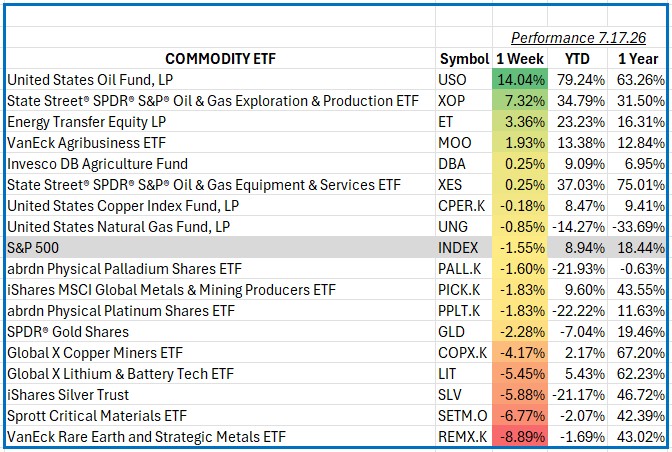
The S&P 500 declined 1.55% for the week ending July 17, 2026, as investors balanced the start of earnings season against persistent inflation concerns and uncertainty surrounding the Federal Reserve’s path for interest rates. While growth-oriented sectors struggled, global commodity markets experienced a sharp divergence in performance. Escalating geopolitical tensions, tighter energy supply expectations, and continued demand resilience supported traditional energy markets, while several industrial and strategic metals retreated as investors reduced exposure to more economically sensitive commodities.
Oil and Gas Exploration & Production was the strongest-performing commodity exposure, advancing 7.3% as crude oil prices climbed on concerns over global supply disruptions and expectations for continued disciplined production from major producers. Independent exploration companies significantly outperformed the broader market, led by ConocoPhillips, Diamondback Energy, EOG Resources, Devon Energy, and Coterra Energy. Higher realized commodity prices, improving free cash flow expectations, and continued shareholder-friendly capital allocation helped attract investors back to the sector after several weeks of consolidation.
Crude oil itself delivered an exceptional week, rising 14.0%, supported by tightening inventories, stronger seasonal fuel demand, and geopolitical developments that raised concerns over potential supply interruptions. The rally extended across the broader energy complex as investors priced in a more constrained supply outlook heading into the second half of the year. Refiners, integrated energy producers, and exploration companies all benefited from improving commodity prices and stronger earnings expectations.
Energy transportation also posted a solid gain of 3.4%, reflecting optimism surrounding stable pipeline volumes and growing North American energy exports. Midstream operators continued to benefit from fee-based business models that generate consistent cash flows regardless of short-term commodity price fluctuations. Industry leaders including Energy Transfer, Enterprise Products Partners, MPLX, Williams Companies, and Kinder Morgan contributed most to the sector’s positive performance as investors favored companies offering attractive income and strong balance sheets.
The weakest areas of the commodity market were Rare Earth & Strategic Metals, down 8.8%, and Critical Minerals, which declined 6.8%. Weakness was driven by softer prices for several battery and specialty metals, slowing demand expectations, and profit-taking following strong gains earlier in the year. Companies including MP Materials, Lynas Rare Earths, Pilbara Minerals, Albemarle, and Sigma Lithium weighed heavily on returns as investors reassessed near-term supply and demand dynamics despite favorable long-term trends tied to electrification, renewable energy, and advanced manufacturing.
This week’s commodity markets highlighted the importance of diversification across the natural resource value chain. Energy-related assets benefited from improving supply-demand fundamentals, while strategic metals experienced a healthy correction. As earnings season progresses and geopolitical developments continue to influence commodity prices, investors are likely to remain focused on sectors with durable cash flows and strong long-term demand drivers.