
COMMENTARY:
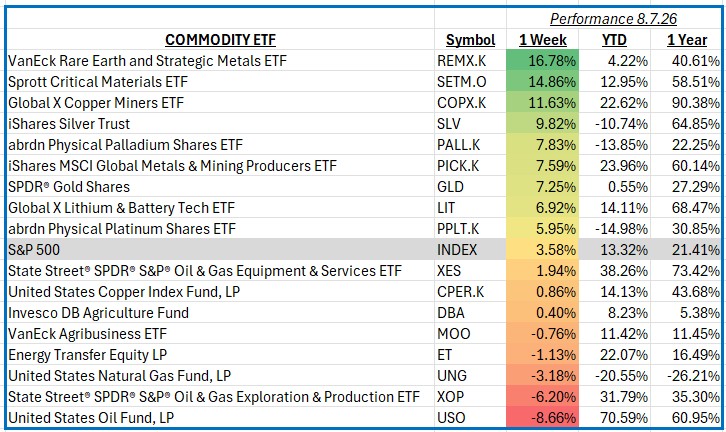
The S&P 500 Index gained 3.58% for the week ending August 7, reaching a new record high as investors responded positively to softer labor-market data and falling Treasury yields. Within global commodities, the story was much more mixed. Precious metals and critical-mineral equities strengthened, while crude oil weakened sharply as markets weighed the possibility of improved traffic through the Strait of Hormuz. Brent crude finished the week down roughly 5%, while WTI declined about 7.7%, despite Friday’s rebound.
The strongest portion of the commodity complex was rare earths and strategic metals, where the group gained 16.78%, outperforming the S&P 500 by 13.20 percentage points. Critical materials followed with a 14.86% gain, while copper miners advanced 11.63%. Rare-earth producers such as MP Materials and Lynas Rare Earths were important contributors, while Freeport-McMoRan provided meaningful exposure across both critical materials and copper. The rally reflected continued investor enthusiasm surrounding U.S. efforts to strengthen domestic critical-mineral supply chains and reduce reliance on China.
The 11.63% gain in copper miners was 8.05 percentage points ahead of the S&P 500 and trailed the rare-earth group by 5.15 percentage points. Freeport-McMoRan, Southern Copper and other major copper producers benefited as investors continued to focus on long-term demand from electrification, infrastructure and data-center construction. The critical-materials group’s 14.86% return was 3.23 percentage points below rare earths but 3.23 points above copper miners, illustrating the breadth of the move across strategically important metals.
At the opposite end, oil and gas exploration and production declined 6.20%, underperforming the S&P 500 by 9.78 percentage points and lagging the critical-minerals groups by more than 20 percentage points. Producers including ConocoPhillips, EOG Resources and Diamondback Energy were pressured by falling crude prices. The oil market exposure fell 8.66%, 2.46 percentage points worse than exploration and production and 12.24 points below the S&P 500. Importantly, this exposure tracks crude futures rather than individual stocks. Oil prices fell as investors anticipated potential progress toward reopening the Strait of Hormuz, although uncertainty remained high.
Elsewhere, gold and silver strengthened as investors continued to seek precious-metal exposure, while platinum and palladium also moved higher. Natural gas posted a modest gain, while agricultural commodities were comparatively restrained. Across the broader commodity value chain, the contrast was clear: precious and critical metals attracted capital, while energy remained constrained by geopolitical uncertainty and changing expectations for Middle Eastern supply. Gold finished the week around $4,341 per ounce and silver near $63.50.
The week highlighted a significant rotation within commodities. Critical minerals and precious metals dramatically outpaced the broader equity market, while oil-related investments lagged. For investors, the key takeaway is that commodity performance remains highly differentiated, with geopolitical developments, supply-chain policy and long-term electrification trends driving very different outcomes across the complex.