

COMMENTARY:
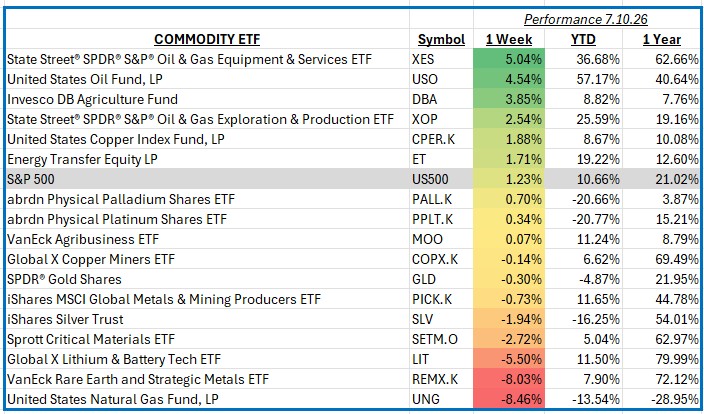
The S&P 500 advanced 1.23% during the week ending July 10 as investors continued to respond positively to resilient economic data, moderating inflation, and expectations that the Federal Reserve may keep interest rates steady in the near term. Commodity markets reflected an improving outlook for global economic growth, with stronger energy prices and resilient agricultural markets offsetting weakness in natural gas and select industrial minerals. Investors remained focused on supply dynamics, geopolitical developments, and seasonal demand trends, all of which influenced performance across the global commodity value chain.
Oilfield equipment and services was the week’s strongest-performing commodity-related theme, advancing 5.0%. Higher crude oil prices, expectations for robust summer fuel demand, and continued discipline among major oil-producing nations supported optimism for increased drilling activity and capital expenditures. Oilfield service providers led the gains, with SLB, Halliburton, Baker Hughes, TechnipFMC, and NOV among the largest contributors. Investors also responded favorably to improving earnings expectations as exploration and production companies maintained healthy spending plans supported by stronger energy prices.
Crude oil also delivered a strong week, gaining 4.5% as improving demand expectations and tightening global supply supported prices. Continued production discipline from major exporting nations and expectations for healthy travel demand helped lift sentiment across the energy complex. Agriculture followed closely behind, rising 3.9% as weather-related production concerns and steady global demand supported prices for several key crops. Companies benefiting from higher agricultural activity, including Deere, Corteva, Archer-Daniels-Midland, Bunge Global, and Mosaic, contributed positively as investors anticipated improved farm profitability and continued investment in agricultural productivity.
Natural gas was the weakest-performing commodity, falling 8.5% as cooler weather forecasts, ample storage inventories, and softer near-term electricity demand weighed on prices. Despite ongoing exports of liquefied natural gas, domestic supply remained more than sufficient to meet expected demand, leading traders to reduce bullish positions. The decline highlighted the commodity’s continued sensitivity to weather forecasts and inventory data, even as the longer-term outlook remains supported by expanding export capacity.
Rare earth and strategic minerals also struggled, declining 8.0% amid renewed concerns about slowing global manufacturing activity and softer demand for electric vehicle supply chains. Producers of lithium, rare earth elements, and other strategic minerals experienced broad-based weakness as investors reassessed near-term demand expectations. Companies including Albemarle, MP Materials, Pilbara Minerals, Lynas Rare Earths, and Sociedad Química y Minera de Chile were among the largest detractors as commodity prices and sentiment across the battery materials sector softened.
Overall, commodity markets reflected a constructive backdrop for traditional energy and agriculture while highlighting continued volatility in more specialized resource markets. As investors look ahead, global growth expectations, geopolitical developments, and second-quarter earnings will remain key drivers of commodity performance and broader market sentiment.